
The story
A History of the Bakery
From the first flatbreads baked on hot stones to the sourdough queues of modern Australia — the story of the bakery is the story of civilisation itself: of grain, fire, community, and daily bread.
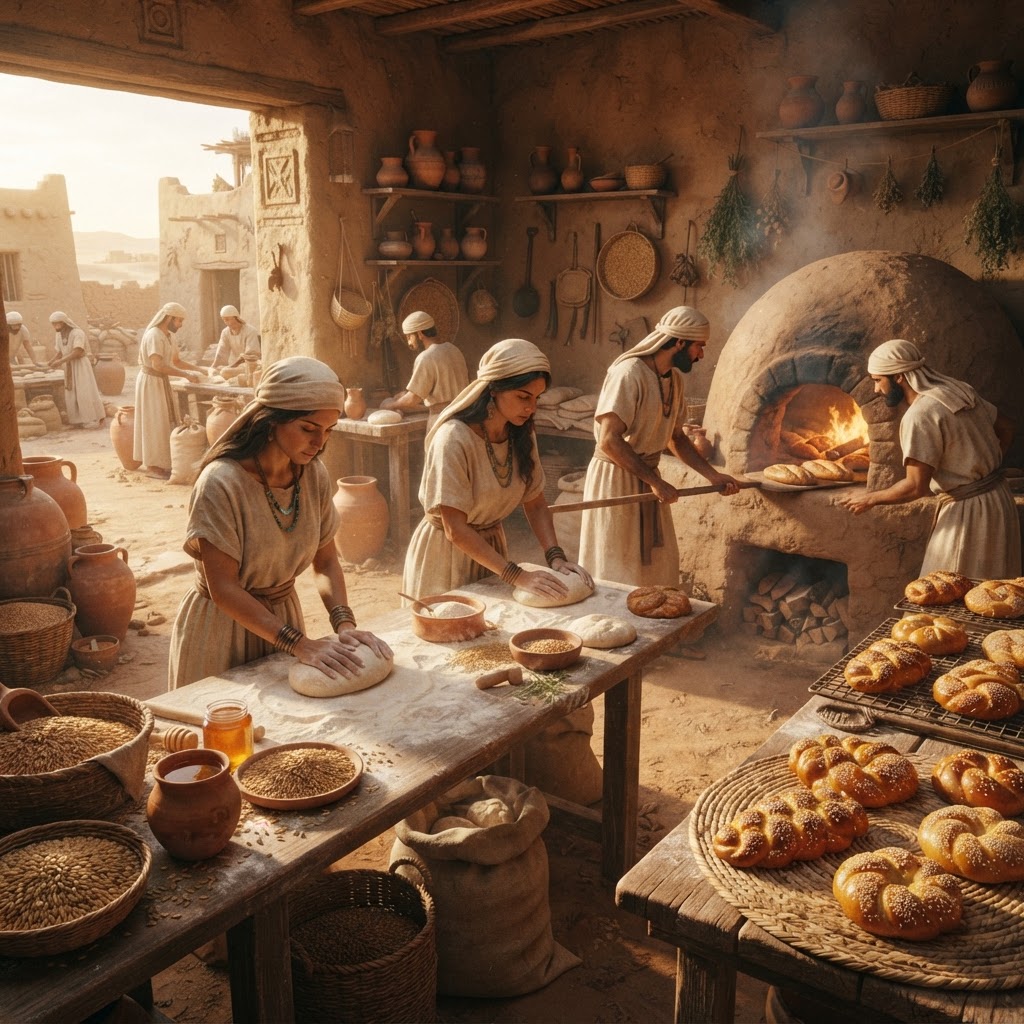
c. 8000 BCE
The Ancient World — Grain, Fire & the First Loaves
Bread is older than the wheel. The first bakers ground wild grains between stones and cooked rough flatbreads on hearths — and when Egyptians discovered that dough left in the warm Nile air would rise, leavened bread was born. Egypt built the world's first true bakeries: state-run bakehouses produced thousands of loaves a day to pay workers, and bread was so central to life that it doubled as currency and offering to the gods.
Greece raised baking into a trade — Athens had public bakeries by the 5th century BCE — and Rome industrialised it. By 100 BCE, Rome counted more than three hundred professional bakeries run by a formal bakers' guild, the Collegium Pistorum, whose members were so vital to the state that they were forbidden from leaving the profession. The daily bread ration kept the empire quiet; 'bread and circuses' was not a metaphor.
In Rome, bakers were so essential they were forbidden by law from quitting.
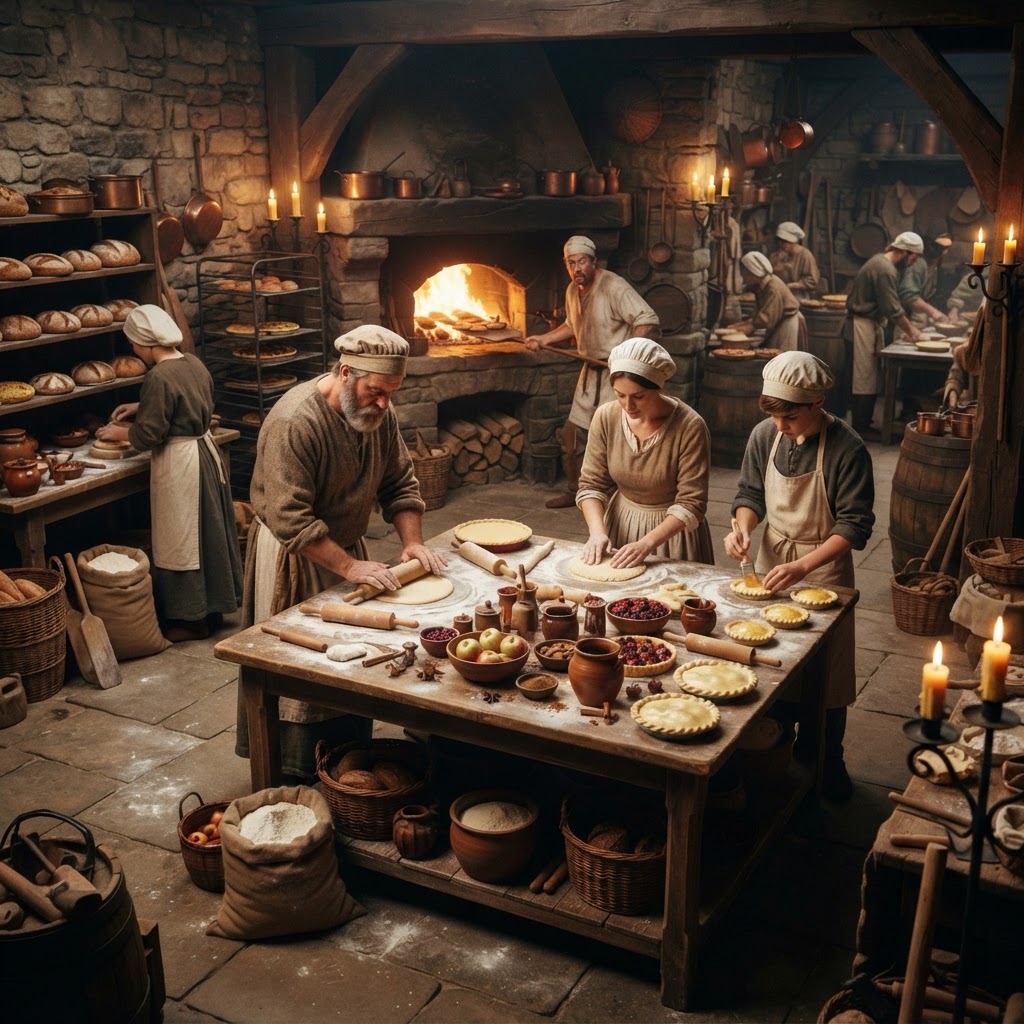
500 – 1500 CE
The Middle Ages — Guilds, Mills & the Baker's Dozen
In medieval Europe the bakery became the heart of every village. Watermills and windmills ground the grain, communal ovens baked the parish's loaves, and bakers' guilds guarded the craft through apprenticeships that lasted seven years or more. Bread was so important that its weight and price were fixed by law — England's Assize of Bread, enacted in 1266, punished short-weight bakers so harshly that they threw in a thirteenth loaf to be safe. The baker's dozen was born of fear.
Rank was baked into the loaf itself: the nobility ate fine white manchet, tradesmen ate wheaten bread, and the poor ate dark rye and barley — while stale trenchers of bread served as the plates of the age. The great raised pie also emerged in this era, its thick crust a container, an oven and a plate in one: the direct ancestor of the meat pie Australians queue for today.
The thirteenth loaf was insurance — short-weight bakers faced the pillory.

1500 – 1800
Empires of Wheat — Bread as Power
As Europe's empires spread, wheat travelled with them — to the Americas, to the Cape, and eventually to Australia. At home, bread remained the fault line of politics: the price of a loaf could steady a kingdom or bring one down. When flour ran short in Paris in 1789, the bread riots that followed helped ignite the French Revolution. No food in history has toppled more governments.
The same centuries refined the baker's art. Viennese bakers pioneered steam ovens and fine yeasted doughs; French bakers codified the baguette's ancestors; and the village bakehouse evolved into the shopfront bakery, with its window of loaves, buns and pies — a template that would sail to the ends of the earth, including a small penal colony on the shores of Sydney Cove.
No food in history has toppled more governments than bread.

1788 – 1900
Colonial Australia — Damper, Drays & the First Bakehouses
Australia's baking story begins with damper — the swagman's loaf of flour, water and salt, baked in the ashes of a campfire. But the colony wanted proper bread, and it wanted it fast: the First Fleet carried millstones, and by the 1790s Sydney had licensed bakers working from wood-fired brick ovens. As the gold rushes swelled the towns, every main street gained its bakehouse, its cart, and its pre-dawn glow.
By the late 1800s the Australian bakery had found its own voice: golden-crusted high-top loaves, the meat pie perfected for hungry miners and footy crowds, and morning teas built on scones, rock cakes and jam tarts. The country bakery — with its date scones, cream buns and vanilla slices — became one of the most beloved institutions in Australian life, as essential to a town as the pub and the post office.
Every gold-rush main street had three essentials: a pub, a post office and a bakery.

1900 – 1980
The Corner Bakery — Pies, Lamingtons & the High Street
The twentieth century was the age of the corner bakery. Horse-drawn bread carts delivered warm loaves to the doorstep into the 1950s, and the bakery window became a gallery of Australian classics: lamingtons dreamed up in Queensland around 1900, the vanilla slice — lovingly nicknamed the 'snot block' — the finger bun, the neenish tart, and above all the meat pie, by now the undisputed national dish, sold in the millions at football grounds every winter.
Then came industrialisation. From the 1960s, factory bread lines and supermarket shelves nearly wiped out the independent bakehouse; sliced white bread in plastic became the default, and thousands of family bakeries closed. But the craft never quite died — in country towns and migrant suburbs, Vietnamese, Greek, Italian and Lebanese bakers kept real ovens burning, quietly reshaping what an Australian bakery could be.
The meat pie became the national dish — sold by the million every winter Saturday.

1980 – Today
The Artisan Revival — Sourdough & the New Australian Bakery
In the 1980s and 90s a counter-revolution began: bakers returned to stone-milled flour, wild yeast starters and long, slow fermentation. What started in a handful of pioneering bakeries grew into a national movement — by the 2010s, Australia's cities were producing sourdough, croissants and pies ranked among the best in the world, and the dawn queue outside a great bakery had become a weekend ritual.
Today's Australian bakery is a proud hybrid: French lamination and Japanese milk breads beside meat pies and lamingtons, native wattleseed and macadamia folded into ancient techniques, and a new generation of bakers treating a humble loaf with the seriousness of fine wine. Ten thousand years on, the essentials are unchanged — flour, water, salt, fire, and someone willing to rise at 3am so the rest of us can eat well.
The dawn queue outside a great bakery has become Australia's weekend ritual.
Epilogue
"Ten thousand years after the first grain was ground between stones, we still queue at dawn for a warm loaf. Some hungers are older than history."